Friday, March 31, 2023

Show HN: Smart Rabbit answers children's questions and is funny https://ift.tt/8f5kalJ

Show HN: Smart Rabbit answers children's questions and is funny My Story : There was a group of parents who struggled to answer their children's difficult questions. They found themselves stumped by their children's curious minds and wanted to provide them with the best possible answers. One day, a developer student decided to create an AI project that could help both parents and children. He worked tirelessly, designing and developing a system that could analyze and understand children's questions and generate appropriate responses. Finally, after months of hard work, the Smart Rabbit project was born. Parents and children alike were thrilled with the results, and the project quickly gained popularity.. website: https://ift.tt/jUFEwdh thankful for your review! https://ift.tt/189HXwh March 30, 2023 at 01:34AM

Show HN: Walkie-Talkie for Badass Developers https://ift.tt/I6muEqX

Show HN: Walkie-Talkie for Badass Developers https://www.flowy.live/ March 31, 2023 at 03:37AM

Show HN: RoboPianist, a piano playing robot simulation in the browser https://ift.tt/lVIZAjY

Show HN: RoboPianist, a piano playing robot simulation in the browser https://ift.tt/ATrhwOX March 30, 2023 at 10:52PM

Show HN: Simple test, can ChatGPT group chat? https://ift.tt/gvYHumD

Show HN: Simple test, can ChatGPT group chat? I just wanted to see if ChatGPT could interpret a group chat, and each individual message, and determine whether true or false to respond and, subsequently respond if true. It's running live right now (It's just a 10m script nothing too serious). https://ift.tt/kgmnzH7 March 31, 2023 at 12:43AM

The Municipal Railway Planning Division & The First 5-Year Plan

The Municipal Railway Planning Division & The First 5-Year Plan
By Kelley Trahan

The San Francisco Municipal Railway 5-Year Plan, 1979-1984 was the first comprehensive service plan created by the first San Francisco Municipal Railway transportation planners. The plan introduced a grid system to provide more efficient crosstown service with better neighborhood connections that would improve access and increase ridership, moving away from Muni’s prior service design focused on trips to and from downtown. It also provided service standards, including coverage, capacity and stop spacing, many of which continue to inform Muni planning efforts today. The San Francisco Municipal Railway saw many changes at this time, including the opening of the Muni Metro, the conversion of some lines from diesel to electric trolley bus, a simplified fare structure and increased fares and historic streetcar service on Market Street. 

Prior to the mid-1970s, the San Francisco Municipal Railway’s service development was determined by a mix of privately-operated transit systems it had acquired, rather than one master transit plan. This changed when the federal government required the agency to submit a 5-year plan to be eligible for funding.  

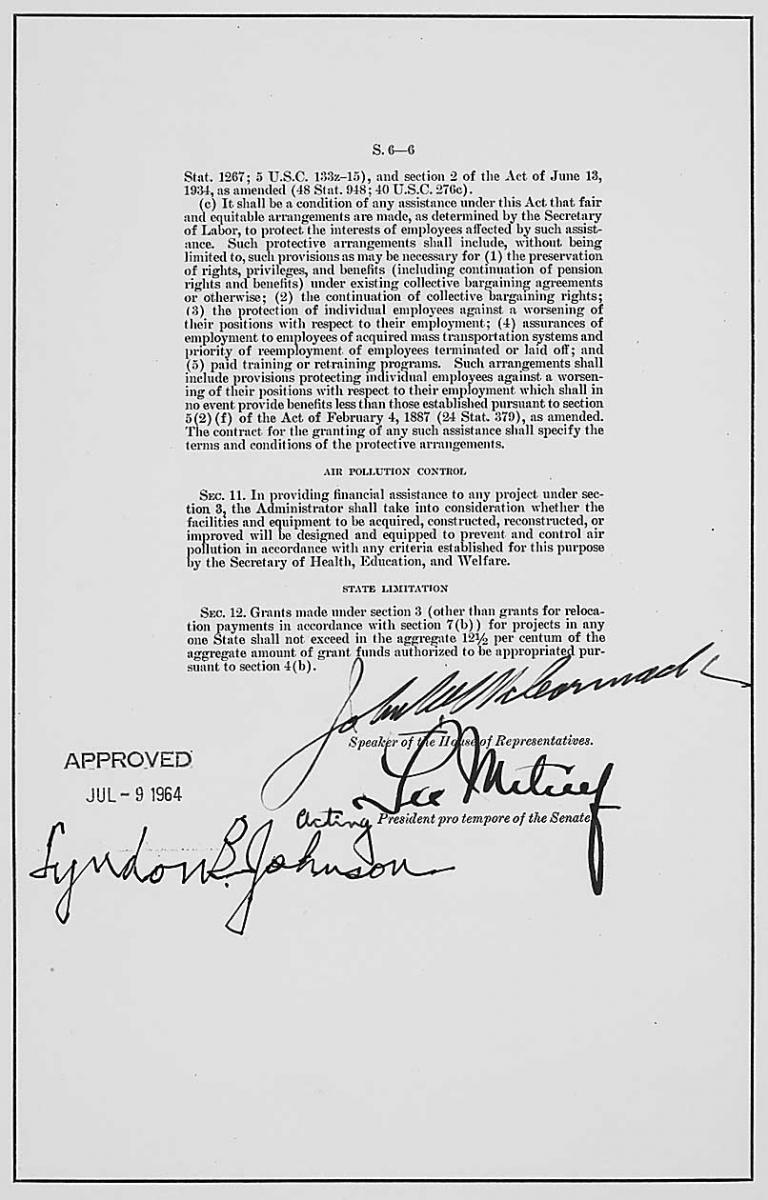
The entire process began when President Lyndon B. Johnson signed the Urban Mass Transportation Act of 1964 into law in response to the nation’s long-term transportation investment needs. The new law provided grant and loan money to local transportation systems and created an oversight agency, the Urban Mass Transportation Administration (UMTA), which would be renamed the Federal Transit Administration (FTA) in 1991. The Metropolitan Transportation Commission (MTC) then was put together by the California State Legislature in 1970 and tasked with reviewing transportation grant applications submitted by agencies in the state. 
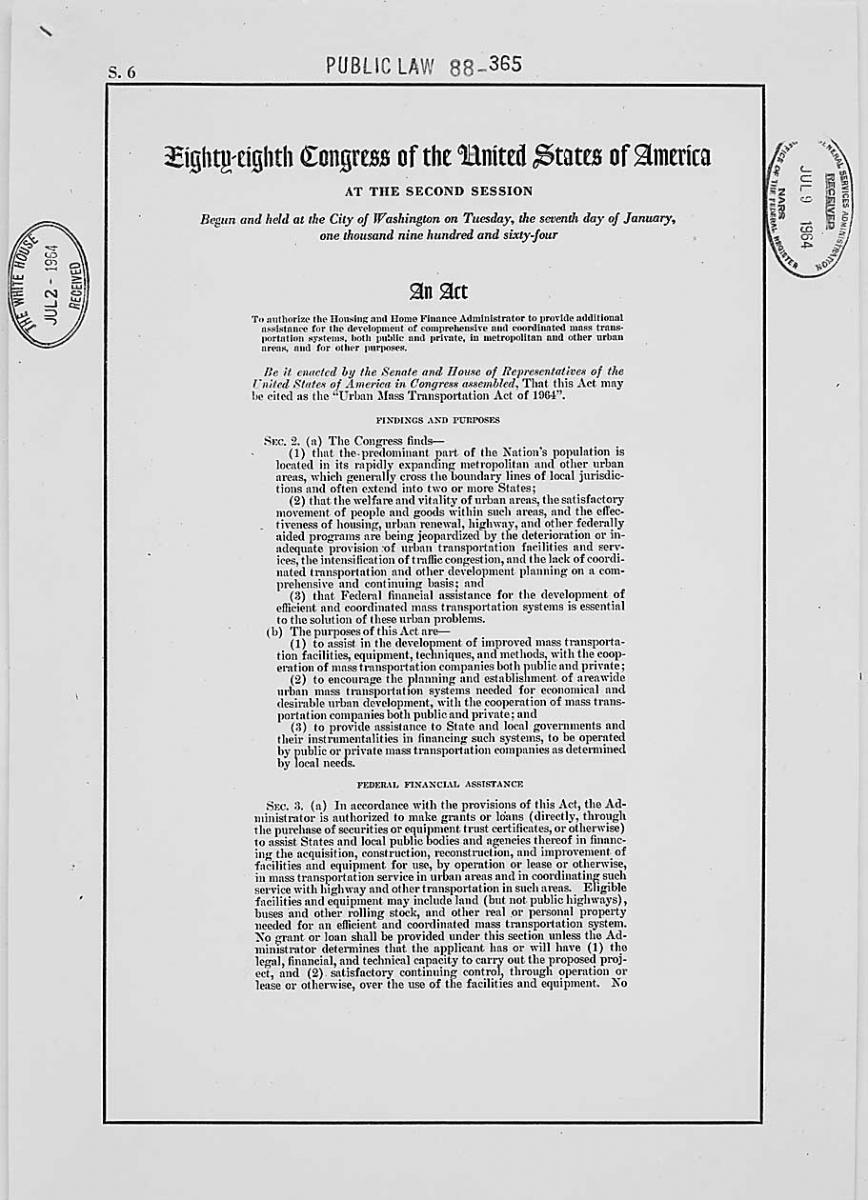
Text of documentation with signatures towards the bottom of the page with time stamped notation of 1964


Text of documentation with signatures towards the bottom of the page with time stamped notation of 1964

Urban Mass Transportation Act of 1964, Public Law 88-365, 78 STAT 302

An in-depth study of Muni was undertaken in 1974 by Wilbur Smith & Associates, a private consultant and author of the UMTA’s Characteristics of Urban Transportation Demand: A Handbook for Transportation Planners. The Municipal Railway Planning, Operations and Marketing (POM) Study was completed in 1977 and analyzed the Muni system and the travel needs of its riders and made recommendations for a 5-Year Plan. 

 A new in-house Muni Planning Division that had been created with UMTA funding in 1974 presented the POM Study at more than 70 community meetings, and after intense review and several revisions, The San Francisco Municipal Railway 5-Year Plan, 1979-1984 was drafted. 
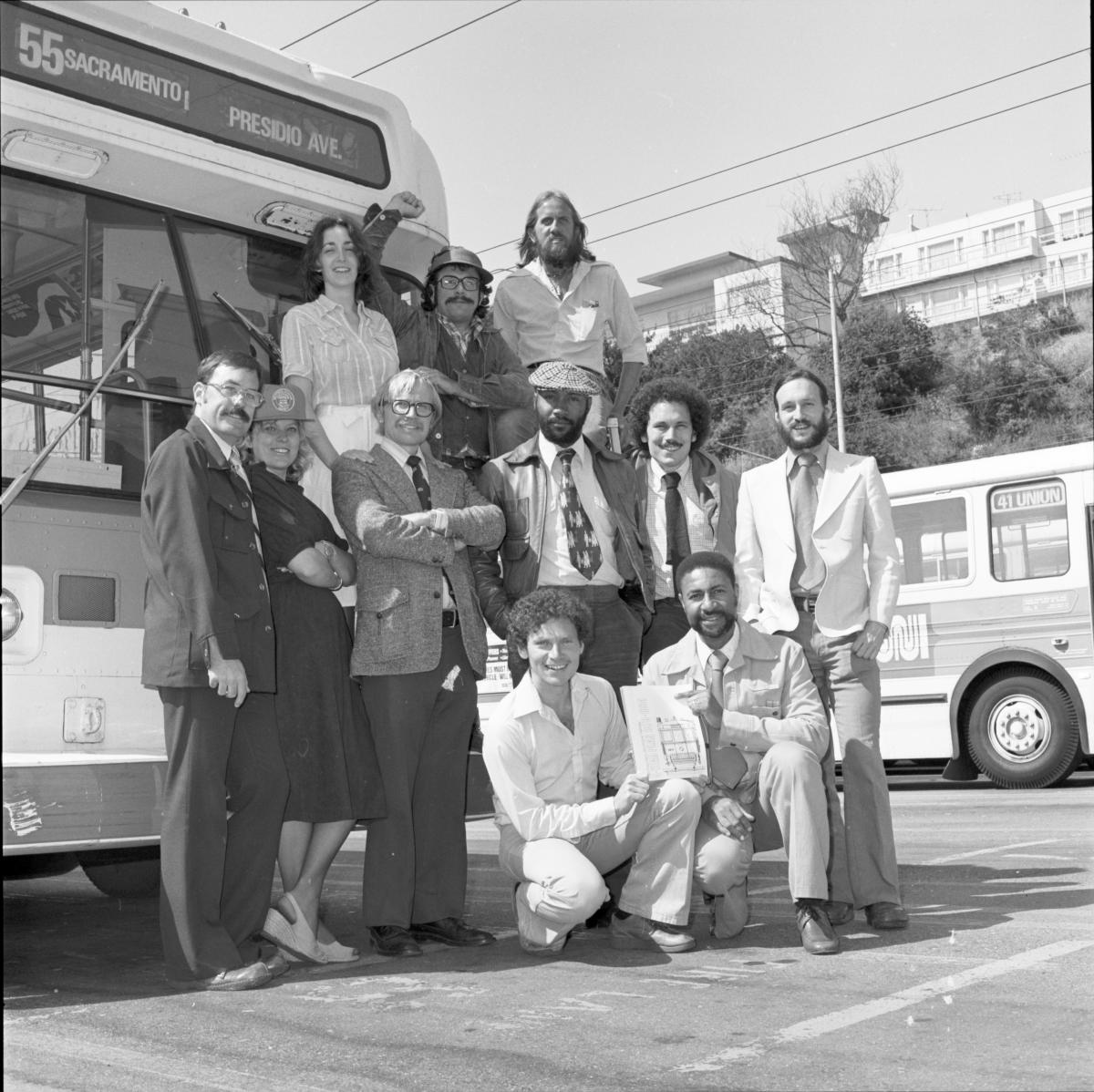
A dozen people dressed in business casual posting for a group photo in front of a bus in what seems to be a bus yard. They are positioned in several different tiers.

Muni Planning Division Employees in Presidio Trolley Coach Yard, May 17, 1979

Since that first plan was written, transportation planning at the SFMTA has expanded to include capital projects, street design, bike lanes, paratransit, parking, historic streetcars and much more, while promoting safety, equity and sustainability. The SFMTA continues to publish an operating and service plan approximately every 10 years, now called the Short-Range Transit Plan (SRTP), which is based on the needs, goals and agency priorities to serve the people of San Francisco. 


Published March 30, 2023 at 11:56PM
https://ift.tt/viy0xaI

Show HN: Kaskada – modern, open-source event processing https://ift.tt/CYfTEQm

Show HN: Kaskada – modern, open-source event processing We recently open-sourced Kaskada – an event-processing engine built on Rust and Apache Arrow. It features a high-level, declarative query language designed specifically for reasoning about events in bulk and in real time. Unlike SQL, an aggregation over events produces a timeline indicating the value at each point in time over the events that have occurred up to that point in time. The query language provides composable, expression oriented syntax, including the ability to nest aggregations. Due to the focus on events and temporal queries, it provides capabilities to shift events forward (not backward, to avoid "leaking" information about the future into past values), ticks that create new times (allowing you to observe the current value of an aggregation every day, for instance) and joins that operate "at the current time". Example query: # Purchases up to a point in time let purchases_now = count(purchase) # Shift that *forward* one day (so the value now is from 1 day ago) let purchases_yesterday = purchases_now | shift_by(days(1)) # Compute the difference (purchases since yesterday) in purchases_now - purchases_yesterday More on the history of Kaskada is available in this blog post https://ift.tt/pcmKbIX . More information on the project (and documentation) is available at https://kaskada.io . https://ift.tt/ItCkj9W March 30, 2023 at 11:57PM

Thursday, March 30, 2023

Show HN: GitHub Annotations for flake8 with my plugin https://ift.tt/mSoCOfX

Show HN: GitHub Annotations for flake8 with my plugin I made a plugin for the Python linter flake8 that turns it's output into Github Annotations by invoking it with `flake8 --format github`. https://ift.tt/InRmgUX March 30, 2023 at 02:18AM

Show HN: Petri – Drop-in Postgres image that forks a DB per test https://ift.tt/APIWNEf

Show HN: Petri – Drop-in Postgres image that forks a DB per test Rolling it out at work to parallelize 4,257 tests across 5 services. It fix...