Friday, September 30, 2022

Show HN: Jsonnet Course Online https://ift.tt/ePhv1kn

Show HN: Jsonnet Course Online Hi HN! I'm usually a lurker here, but I wanted to share this: I'm an enthusiastic user of Jsonnet[1] to flexibly generate JSON and YAML files (eg for kubernetes configurations). I wanted to spread awareness of Jsonnet and made a course on Udemy. The first 1000 students enrolling within 5 days with this link get the course for free: https://ift.tt/bKAzXQk... I hope you enjoy the course (I'm interested in your feedback!) and if it makes you start using Jsonnet it will be mission accomplished :-) [1] https://jsonnet.org/ https://ift.tt/BVpTCoc September 30, 2022 at 01:19PM

Show HN: Red Goose – Convert your website to mobile app https://ift.tt/2G0TWuO

Show HN: Red Goose – Convert your website to mobile app Hi HN! We're Sonica, Marvin, and Satie, and we are building Red Goose (https://goose.red). Red Goose is a web app to mobile app conversion engine that produces ready-to-publish apps for the app stores using GitHub repos. There was a discussion on HN a few weeks ago about how a developer shaved off almost half of their native app's code without losing functionality [1]. Our launch today is a direct outcome of that thread and, moreso, in the context of this comment [2] and this one [3]. Paraphrasing the context below: > "Fastmail is the only email/calendar app with a reasonable size (just 20MB)." Followed by: > "… EDIT: just realized the app is a web view. Sigh." As someone who has been into mobile app development since 2010, the comments above read like a punch to the gut. We grew up believing that the native experience was better than the web! It took a while to admit, but the web, it appears, has genuinely caught on. It has matured to a point where the four pillars of web development—HTML, CSS, JavaScript, and WebAssembly—are likely enough for universal distribution. We already host compute-heavy environments for graphic designers [4], video editors [5], and rich document editing [6] on the web. And there is still more capability [7] in the works, if you will. So the question we asked ourselves was: Could the modern web become the "native stack" of mobile app development? With Red Goose, we want developers to be able to do just that. Create web applications that double up as mobile apps for the app stores. But this isn't always easy. Historically, native mobile apps have differed from (outdone?) the mobile web in three broad ways: An app-specific design language, Smooth and fancy screen transitions and, Solving compute-heavy processes that scaled to millions of users. However, at the same time, building and maintaining native mobile apps is super expensive, and it requires hiring separate teams of experienced developers whose sole job is to focus on mobile APIs. Even with the newest alternatives like React Native, Flutter, Cordova, Xamarin, Ionic, or any other similar framework, there is a quantum increase in the amount of boilerplate code. Over time, as many of us have experienced in the industry, the web and native teams grow distant, leading to a less than optimum situation and bloat. Red Goose puts the webview back in the ring. This step alone removes all the duplicated code from the equation. Red Goose then offers an alternate strategy [8], using the webview as the main leverage over your web app. And solve for native experience in the following three ways: First—Intrinsic Design: we have built a new css framework called Toucaan [9] to tackle the gaps between mobile app design and mobile web. It allows the development of "app-like" interfaces using new css standards and the intrinsic qualities of the medium. Second—Screen Transitions and Animations: Not all apps need this, but smooth transitions and performant animations are already possible with the new web APIs. With a strongly cached webpage using a service worker (PWA) and a better understanding of initial containing blocks (ICBs) pertaining to your front end, one can easily take steps to take the experience to the next level. Third—Webassembly: The best thing about webassembly is that the wasm functions return immediately and synchronously. So one can easily offload compute-heavy transactions to a locally installed wasm utility and benefit from performance gains instantly on both web and mobile apps. It appears that many apps wouldn't need to sprinkle webassembly into the mix to reach the level of performance expected of mobile apps, and just caching with a service worker and an app-like layout would do the trick. Red Goose itself uses vanilla javascript and an experimental version of Toucaan for its frontend. Its backend is made with Node.js, Express, and MongoDB and is hosted on AWS within Docker. Our web-to-mobile app conversion pipeline uses NodeGit for app delivery, and the freshly minted mobile apps are written in Swift or Kotlin and shared directly over GitHub. We believe that the opportunity to reduce app development and distribution cost using the newfangled powers of the web is massive—we've already helped a few teams to cut back on their expenses by as much as 80%. At the same time, we're still early and would love to hear what you think about what we're building with Red Goose. We look forward to your comments and experiences, especially if you have been on this path before on your own. Thanks! Relevant links: HN Discussion: [1] https://ift.tt/P9Kkcet [2] https://ift.tt/2nwLKbB [3] https://ift.tt/3v1VlAT Leading web examples: [4] https://ift.tt/K64Vnm9 [5] https://ift.tt/X2x3sDy [6] https://ift.tt/WDlq8gF [7] https://ift.tt/50SHW9z Tooling: [8] https://ift.tt/6anpe2f [9] https://toucaan.com The end. September 30, 2022 at 03:58PM

Show HN: Git in-memory in browser with Web Assembly https://ift.tt/SlpMJTL

Show HN: Git in-memory in browser with Web Assembly Create, upload, edit (multiple) files on the fly, in the browser. Git branches and git commits allow to save your changes, create multiple "workspaces" and switch between them in one click. Repo: https://ift.tt/Z89ovNw https://ift.tt/tW1h4aD September 30, 2022 at 12:20AM

What a Year It Has Been! Let the Celebration of Transit Month Continue

What a Year It Has Been! Let the Celebration of Transit Month Continue
By Erin McMillan
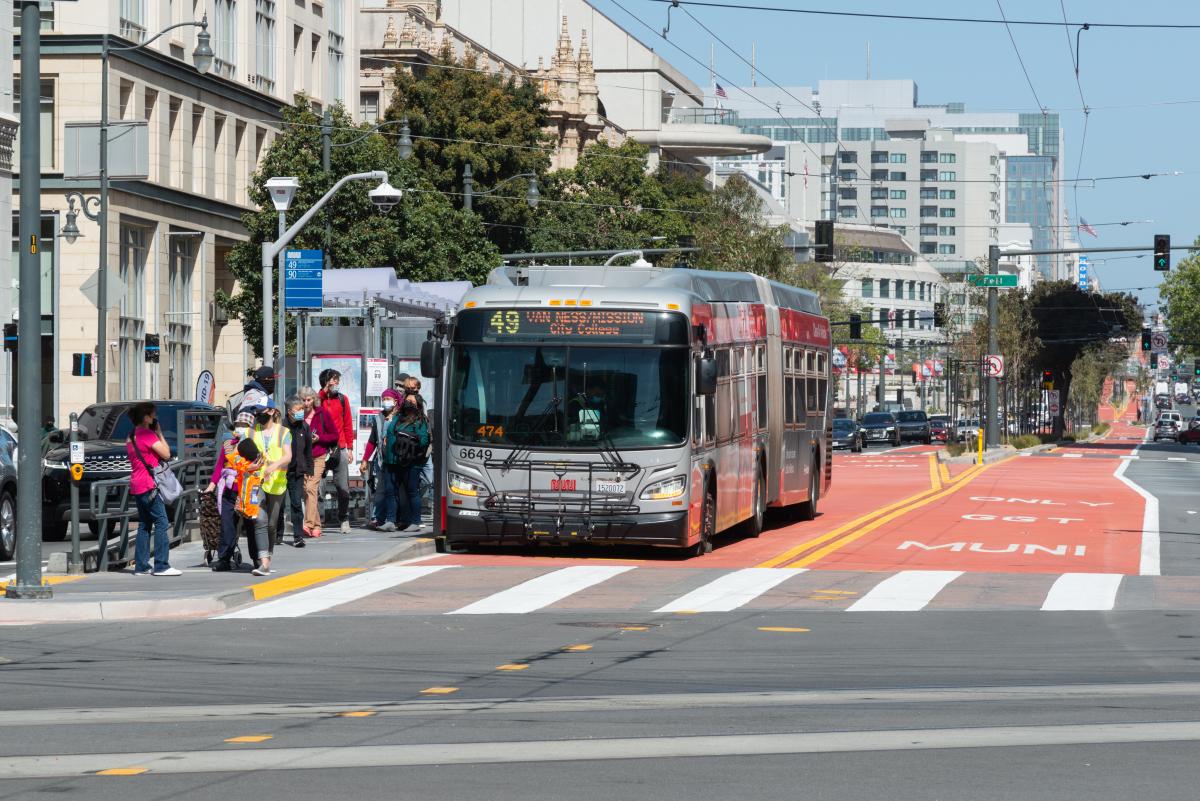
Muni bus stopped at intersection and unloading passengers at bus stop.

49 Van Ness/Mission using the brand new bus rapid transit lanes on opening day in April.

During Transit Month this September, we’re continuing the celebration by looking back to more of the work we’ve done over the last year— some that has been less obvious to Muni customers, but critical to a well-functioning system and other work that is more front and center.

Fix It! Week and Continuing State of good Repair Work

Muni is an impressive transit system. Moving thousands of people on rail and buses every day takes a lot of coordination and a lot of work. Dealing with unique challenges like San Francisco’s geography and shifting travel patterns, we also have to deal with issues related to the Muni system’s age. Proper care and maintenance of a transit system many decades old takes strategic planning as regular maintenance needs to happen while continuing to provide service. Typically, regular Muni Metro maintenance work occurs each night after subway service hours, SFMTA maintenance crews work to maintain the tracks and equipment underground. On most nights, this gives crews only about two hours to get work done. This two-hour window sometimes isn’t enough to complete critical maintenance tasks, so beginning in April, we started Fix It! Week, a quarterly week of planned maintenance that occurs during extended, overnight shifts when trains aren’t in service.

This year Fix It! Week provided 63 total work hours during which several SFMTA teams completed over 2,000 hours of maintenance and inspections. On the busiest nights, the maintenance teams had up to 55 staff in the tunnel from West Portal to Embarcadero delivering safety improvements, station and tunnel enhancements, subway track and wayside equipment maintenance, and traction power upgrades.  

In addition to finding new and creative ways to maintain the system more efficiently, we also had to entirely reimagine the service network to accommodate changing travel patterns and in response to the pandemic. Over the past year alone we’ve increased Muni service multiple times as the impact of the pandemic has eased and we’ve slowly been able to hire new operators.

Trip patterns have changed over the last two years with a noticeable shift in San Francisco residents traveling neighborhood to neighborhood instead of the peak period downtown-centric travel pattern that was prevalent pre-pandemic. And we’ve adjusted. Service is slightly over-supplied so that there is capacity when it is needed. Anticipating how people will move in the future is difficult, but our service planning team is hard at work tracking ridership, customer feedback and operator availability to do our best to accommodate how folks want and need to move around the city. We are working to build back our ridership by providing high-quality, reliable service that people can count on.

Our response was the 2022 Muni Service Network which was developed through an extensive outreach process. Throughout the COVID-19 emergency and recovery, the SFMTA prioritized restoring service to these, and other neighborhoods identified in the Muni Service Equity Plan.

On the more visible side of our work, in April we started bus rapid transit (BRT) service on Van Ness Avenue as part of Muni’s Rapid Network, which prioritizes frequency and reliability for customers. Muni and Golden Gate Transit customers are already experiencing shorter travel times. With dedicated transit lanes in the middle of the street, enhanced traffic signals with Transit Signal Priority, the Van Ness BRT is the fastest way to travel north-south in this part of San Francisco, and riders are noticing. Since the BRT corridor opened on Van Ness Avenue in April, ridership on the 49 Van Ness/Mission has nearly doubled and is exceeding pre-pandemic ridership by 13%.

In other major capital and service news, last October service started on Geary in its new transit lanes after the completion of the Geary Rapid Project. Pre-pandemic, the combined Geary routes had one of the highest bus riderships in the country, with more than 56,000 daily customers relying on the 38 Geary and 38R Geary Rapid. As riders return, they are experiencing a faster, more reliable ride thanks to transit improvements like red colorization and dedicated transit lanes, bus stop optimization and signal retiming that were made along the three-mile stretch of Geary. These quick-build improvements alone resulted in 38R Geary Rapid travel time savings of up to 20%. 

And last but certainly not least, you may have heard we have officially announced the opening of Central Subway! Weekend service starts Saturday, November 19 and will give customers a chance to check out its four new stations, and also allow our operators and crews to work out any kinks while operating. We’re looking forward to welcoming you aboard!

Wishing you a Happy Transit Month! 


Published September 29, 2022 at 11:07PM
https://ift.tt/xBK9h3k

Thursday, September 29, 2022

Show HN: A Node.js SDK to embed zero trust principles in your app https://ift.tt/uQaq9fE

Show HN: A Node.js SDK to embed zero trust principles in your app https://ift.tt/WAHIEUR September 29, 2022 at 05:15PM

Show HN: Restapp.io – SQL Data Modeling Tool in No/Low Code https://ift.tt/boEnF08

Show HN: Restapp.io – SQL Data Modeling Tool in No/Low Code Hey all! We've been working on RestApp V1 and this is our first time posting it on HN. It's an No/Low Code data modeling tool that enables you to build & maintain data pipelines with a visual programming interface. We don't store your data but we compute them through Apache Spark for query speed & efficiency. Here's some features: `Connectors: Connect to any source and destinations (DB, DWH and SaaS Applications). We currently support MongoDB, Snowflake, BigQuery, MySQL, MSSQL, SFTP (JSON, txt, csv, excel files supported), Hubspot, Stripe, GDrive (JSON, txt, csv, excel files supported). `Pipeline: Visual Programming Interface where you drag-and-drop SQL, NoSQL & Python functions instead of writing them to create a query and debug it easily. `Automation: You can automate your data pipeline (Job) through a scheduler. `Domain: Think of it like a workspace in which you can share securely your connectors and pipelines to specific users (colleagues, partners, clients...) We've designed this because as a data team member, we were writing a lot of long SQL queries with bad performances and we were getting headaches by debugging them. Now you can build, monitor and debug any kind of data pipelines with just Drag-and-drop built-in SQL functions to save you tremendous amount of time & effort. We're working on this continuously so we're keen to hear any feedback. Feature requests and critique are more than welcome. Try it out for free (30min of computing time offered each month): https://ift.tt/HNBkamF The Getting Started docs are here for anyone who wants to check this out: https://ift.tt/qyEtkAb and https://ift.tt/vu94ZWY... https://ift.tt/HNBkamF September 28, 2022 at 03:44PM

Show HN: ButtFish – Transmit Morse Code of chess moves to your butt https://ift.tt/juJiXWH

Show HN: ButtFish – Transmit Morse Code of chess moves to your butt https://ift.tt/sL9NiRV September 29, 2022 at 04:25AM

Show HN: 3D-Agent – AI that edits Blender scenes through the Python API https://ift.tt/K8jQOZb

Show HN: 3D-Agent – AI that edits Blender scenes through the Python API https://ift.tt/qVL1uH2 May 14, 2026 at 08:17PM