Wednesday, May 4, 2022

Show HN: A simplified Wave Function Collapse algorithm (part 2) https://ift.tt/tI1BrC5

Show HN: A simplified Wave Function Collapse algorithm (part 2) https://ift.tt/TxsJOm4 May 4, 2022 at 05:51AM

Show HN: Self-hostable app to send push notifications and files to phone/desktop https://ift.tt/dogmpxk

Show HN: Self-hostable app to send push notifications and files to phone/desktop https://ntfy.sh May 4, 2022 at 12:58AM

Making Way for the Muni Metro of our Dreams

Making Way for the Muni Metro of our Dreams
By Erin McMillan

In order to achieve the SFMTA’s vision for transit service, we have some work to do. Staff have provided an overarching framework for how SFMTA will achieve a truly dazzling vision for Muni service: The Muni Metro Modernization program. 
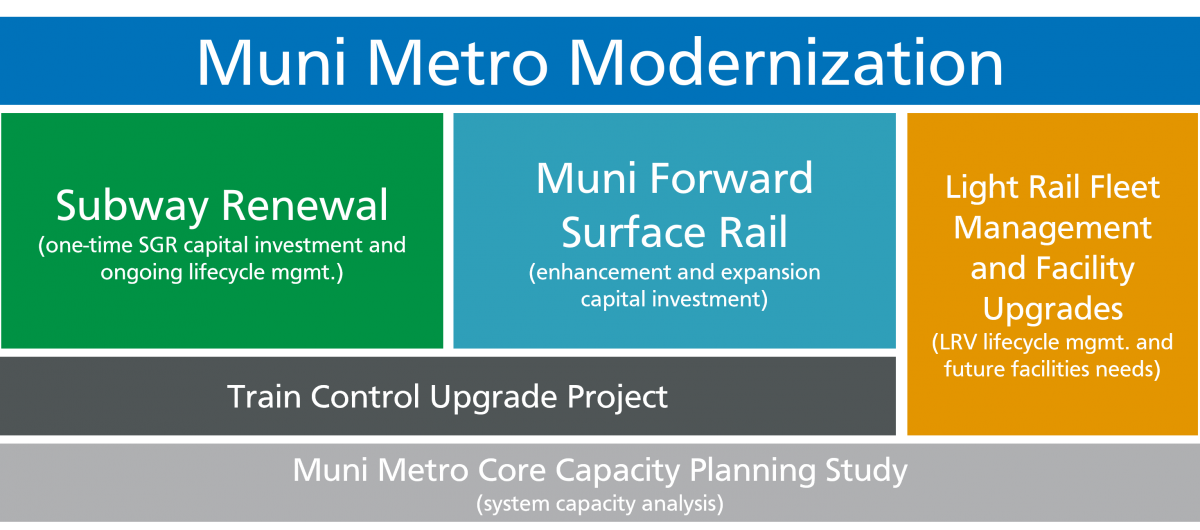
Chart showing the projects that fall under the Muni Metro Modernization program.

The Muni Metro Modernization program. 

The program uses a multifaceted approach: As a foundation, making state of good repair upgrades and replacing aging systems through our Subway Renewal Program already underway. San Francisco's Muni Metro subway system moves our highest volumes of customers through the core of the city. And it operates on infrastructure that was constructed between 50 to 100 years ago, much of it original. It is well-documented that Muni Metro has been plagued with service reliability problems for decades. The Subway Renewal Program lays out a systematic approach to capital upgrades over the next ten years, targeting strategic repairs, replacing and enhancing our most critical systems. This work will improve our subway’s resilience and prepare it for the demands of the future. Much of this work over the next ten years include things that customers never see, but are essential to keeping the system safe, efficient and reliable.  

Another major project that will increase the Muni Metro network’s capacity, and reduce wait times and crowding on your Muni Metro trips:  the Train Control Upgrade Project (TCUP). TCUP possesses the greatest potential of any single investment to significantly improve system efficiency. Our outdated centralized train control system is under constant pressure and is increasingly operating beyond the capacity for which it was designed nearly three decades ago. 

While we’ve learned operational and service lessons throughout the pandemic, we’re continuing to improve our ability to measure the health of the subway. Using data dashboards to monitor subway travel time, queuing, average daily subway delay and maximum trains per hour, we’re improving our ability to make informed decisions about subway operations and service. Following the successful pilot of the J Church surface-only route, we’re looking for ways to increase our adaptability and improve responsiveness to changing travel patterns.  

In addition to improving subway infrastructure and performance, the Muni Forward program will focus on improving surface rail through capital improvements that will increase the reliability and performance of the line segments operating outside of the subway. Customers will continue to feel the positive impacts from the Muni Forward program with more reliable surface rail service that translates into a more reliable subway.  

The Train Control Upgrade Project bridges state of good repair improvements and service improvements by replacing a 20+ year old system in the subway and expanding new technology to the surface. And of course, strategic investment in our light rail fleet and facilities is critical to achieve this work.  

In addition to improving the infrastructure and service of Muni Metro, we are also planning for the future. The Muni Metro Core Capacity Planning Study sets out to answer critical planning questions for our system— What is our future higher-capacity transit system?​ What is the program of infrastructure projects and service that will get us there?​ How can we get more capacity in the subway and at the same time improve reliability? We have already begun to experiment with innovative service approaches, such as the J Church Surface-only Pilot, as a way to test some of the service ideas that will be explored further in the Core Capacity Planning Study. Building upon the work laid out in the Metropolitan Transportation Commission Bay Area Core Capacity Transit Study and the ConnectSF Transit Strategy, the Core Capacity Planning Study will develop a comprehensive long-term strategy for expanding the capacity of the Muni Metro system.  

We know what the issues with Muni Metro are—and we have the tools and programs in place to improve the system. From capital improvements like train control system upgrades to improving our service performance through the Muni Forward program and innovative service solutions like the J Church Surface-only Pilot, we’re working to improve the reliability and service of the Muni Metro both in the near and long term. 

For more information, visit the Muni Metro Modernization Program page.


Published May 04, 2022 at 01:20AM
https://ift.tt/atkM0nu

Tuesday, May 3, 2022

Show HN: Kontxt – Social web layer with CMS and social network https://ift.tt/P2EwF7t

Show HN: Kontxt – Social web layer with CMS and social network Hey, I’m Dave, the founder of Kontxt.io ( https://www.kontxt.io ). Engage directly on the web and save, organize, and share highlights and notes. Follow people. Join groups. And search content. Here’s a 2-minute demo ( https://youtu.be/Th4vaOzuGnU ). It works on desktop and mobile. The web layer is like Google-Doc collaboration on the entire web, and it’s connected to a web app that’s like a combo of DropBox to save and organize your findings, and Twitter/Reddit to share and discover bite-sized article highlights with other people. 1.) The Social Web Layer has rich collaboration features with privacy and share controls: Inline highlights, tags, polls, comments, @mentions, deep-links to anything you add to the page, and navigation between parts. The web layer can be added to any site or PDF with a single line of javascript. This is done with a browser extension, bookmarklet, or added to a page directly by the site owner with the word-press plugin or hard-coded javascript. 2.) The CMS and Social Network lets you organize with folders that have privacy and share controls, a profile with your public highlights, a feed of highlights from people you follow, groups with feeds around topics, and the ability to search your content and what others share publicly. For years, I had a long commute, so I read online a lot–from HN, of course. There’s too much to read everything, and you only know if an article is “worth-it” after you read it. Then it hit me. Highlights! 1.) On the page with navigation, 2.) visible before you open the link, and 3.) to increase quality and relevance, follow and search highlights by trusted people like friends, co-workers, university peers, and industry leaders. There’s too much information and not enough time. Highlights are short, useful, and fast to read. Kontxt.io lets you direct attention to what matters. First, it lets you find quality sources from trusted people, then it lets you focus on the important parts of them. Kontxt basically turns the web into an interactive workspace so you can have rich web interactions with other Kontxt users. Or you can extract highlights into a shareable link and post it anywhere on the web–with analytics for what you share. Highlights are automatically saved to the CMS and based on their privacy settings, may be published to feeds in the social network for others to see. Naturally, you may want to discuss the same site with different people for disparate reasons, so you can create multiple highlight layers on a single site, each with Google-Doc-like sharing, privacy, and authorization controls. It’s now evolved into a general communication and engagement platform for the web. Here’s how Kontxt has been used or where people expressed interest: social news aggregator, productivity, research & planning (generally, and specifically for sales, law, & finance), knowledge-base, training & education, publisher inline-engagement system, etc. Kontxt gets to the point fast. It brings collaboration directly to the web itself and is already part of your natural workflow since it's always with you every click of the way. The social network is unique since it uses highlights to seed discussions. This has many benefits. Highlights mean people have actually read the article, the source is cited, and parts can’t be misconstrued because you have context. It’s also a human filter of the internet. A site is likely worthwhile if someone took the time to highlight it, and if someone found it useful, then someone “like” them probably will, too. Similarly, if someone’s not willing to highlight a site before they send it to you, it’s probably not worth your time. And highlights will increase how many people actually read what you send them because they’re short, useful, and fast to read. I’m excited to share this with all of you. Thanks for your time. Please leave any feedback or questions in the comments. If you try it out, be sure to join the “Hacker News” group. https://www.kontxt.io May 2, 2022 at 11:45PM

Show HN: PostgresML, now with analytics and project management https://ift.tt/WeMUJ3Z

Show HN: PostgresML, now with analytics and project management We've been hard at work for a few weeks and thought it's time for another update. In case you missed our first post, PostgresML is an end-to-end machine learning solution, running alongside your favorite database. This time we have more of a suite offering: project management, visibility into the datasets and the deployment pipeline decision making. Let us know what you think! Demo link is on the page, and also here: https://ift.tt/xYbmt2S https://postgresml.org May 2, 2022 at 11:18PM

Show HN: Free OSS transcription app I made and found it's faster than wispr flow https://ift.tt/jXQh9Tk

Show HN: Free OSS transcription app I made and found it's faster than wispr flow title doesn't let nuance, ofc it's not the app ...